
Consultation & Training
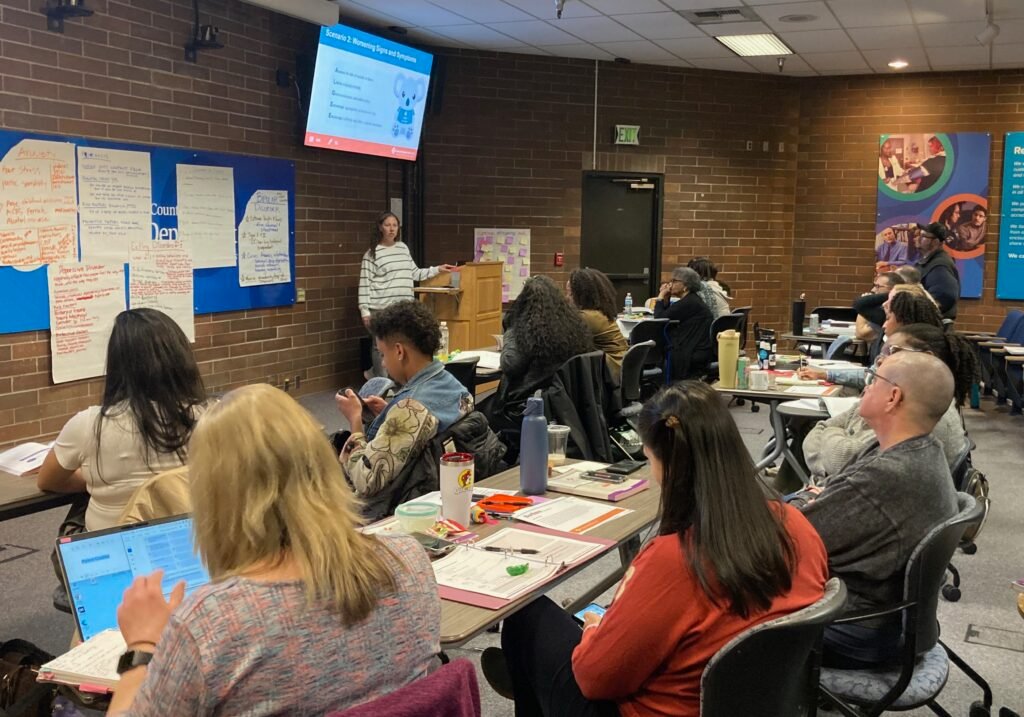
Dianna has had the privilege to train community members locally, nationally, and globally. Over eight years ago, she became a certified facilitator in Mental Health First Aid (MHFA), which sparked a growing passion for community education and support. Since then, she has expanded her work to include training in trauma-informed approaches and social-emotional learning.
She has partnered with organizations such as Tacoma Health Department, City of Renton, multiple school districts across Pierce County, and the Boys & Girls Clubs, delivering trainings across their global network as well as throughout Washington State. At Foundational Roots Therapy and Consulting, we believe these conversations should be accessible, and we are committed to working with nonprofit budgets to bring meaningful, impactful training to your team.
Mental Health First Aid Trainings
There are three tracks: Adult Mental Health First Aid (AMHFA), Adults who serve youth (YMHFA), and teen Mental Health First Aid (tMHFA) where teens support peers: With all three tracks there are three ways we can offer the certified trainings.
- Fully in person: AMHFA- 8 hours: YMHFA-6.5 hours: tMHFA- 3 90 min or 6 45 min
- Blended: up to 2 hours independent pre work via MHFA Connects modules: followed up by in person or virtual 4.5-hour live training
- Fully Virtual: AMHFA- 8 hours: YMHFA-6.5 hours: tMHFA- 3 90 min or 6 45 min via zoom
Youth Mental Health First Aid
Is a national 3-year certification curriculum overseen by the National Council of Behavioral Health. The training is a 6-hour training where attendees will learn how to recognize signs and symptoms of youth experiencing mental health challenges and crises. Attendees will also learn how to respond and assist youth by applying an action plan that leads the trainee to appropriate help. This training also does a deeper dive into assisting youth in Crisis. We will cover recognizing signs and symptoms of crisis, how to assist youth with suicidal thoughts, self-harm, substance abuse/overdose and more. We will also discuss how to connect young people with professionals and caring trusted adults while also addressing cultural stigma that occurs in our communities. MHFA trainings are valued at $170 per person but here at Foundational Roots Therapy and Consulting we are aware that would cause barriers. Let’s talk today to get a quote to train your staff.
AMHFA
Learn how to support your friends, family and neighbors while receiving a three-year certification. Mental Health First Aid (MHFA) teaches you how to identify, understand and respond to signs of mental health and substance use challenges among adults. You’ll build skills and confidence you need to reach out and provide initial support to those who are struggling. You’ll also learn how to help connect them to appropriate support.
TMHFA
Teen Mental Health First Aid is a 3-year certification course compared to CPR First Aid but for mental health challenges and crisis. tMHFA teaches teens grades 9-12 how to identify, understand and respond to signs of mental health and substance use challenges their friends and peers are experiencing. The curriculum covers how to open the conversation about mental health challenges including crises such as self-harm, suicide and substance use, with their friends. The curriculum teaches an action plan that has heavy emphasis on seeking the help of a caring and trusted adult.
Mental Health 101: (With or Without Crisis Response)
Are you serving youth, families or even staff with mental health challenges? This training will cover understanding how mental health shows up in our communities. You will walk away being able to recognize how signs and symptoms show up for folks. Once you know how to recognize signs and symptoms, we will discuss how you can use empathy and listening skills to connect folks with appropriate help. This is a 2-hour training covering just the bare basics of how to recognize and respond to mental health challenges. If you are looking for a little more, we can add content with responding to mental health crisis for an additional 30 min to an hour.
Guiding Good Choices: Parenting Curriculum
Guiding Good Choices is a parent workshop that is a drug prevention program for parents of children ages 9 –14, designed to equip parents with specific strategies to help their children avoid drug use and other adolescent problem behaviors, and develop into healthy adults. This is an interactive workshop that is judgment free where all can share their successes and support each other in our struggles. With this curriculum we know that things have shifted for communities throughout the years when this was created and I use the curriculum as a guide but apply what works for families today. You can take what works and leaves what doesn’t while having a supportive group to connect with.
Secondary Trauma the Importance of Self Care
In this 1.5-2 hour training we will cover brain science and how our brains respond to trauma. We will discuss the different types of stress and how our bodies respond. We will also cover how trauma informed practices guide self care and how to build resilience in ourselves with self care practices. After the groundwork of information is laid we will learn about the Theory of Change and participate with hands-on examples to practice self care tools.
Why and How of SEL: Trauma Informed Practices (With Theory of Change and mindfulness practices)
What is social emotional learning and why do we hear so much about it today? Let’s review the basics of trauma and how our brain and bodies respond. Did you know your brain is built to run on survival mode when it perceives danger? We will dive into this and practice mindfulness tools that can help calm our systems.
Where DEI meets TIA/SEL: Resist to Re- traumatization
In this 3-4 hour training we will cover brain and trauma basics (TIA- Realize/Recognize), How to teach and use tools (TIA-Respond) and end with discussing how DEI work goes hand in hand with TIA work. DEI work must co-exist with TIA so that we do not re-traumatize. We will use scenarios to apply the concepts covered to give hands on examples.
Positive Behavior Management
What is positive behavior management and why should our organizations shift to this lens? Well, we know so much more about our trauma responses now. Let’s learn how we can continue to re-traumatize our we can shift our work and help build life skills and tools and really reach the youth we serve.
Mandated Reporting
We will cover the RCW’s to ensure all attendees know what their legal requirements are as mandated reporters. We will also discuss the importance of having clear and concise policies for your staff to ensure all legal requirements are met. Lastly, we will cover the importance of processing with staff after reporting and its importance in battling secondary trauma.
Secondary Trauma & Self Care
Curabitur egestas ligula ornare sem sagittis tempor. Nam id sem vitae magna cursus accumsan ut id magna. Proin viverra dignissim nisi, a suscipit leo aliquet et. Nullam et lobortis orci.
- Compassionate & Experienced Professionals
- Holistic Approach to Well-Being
- Safe & Supportive Environment
Trauma-Informed Practices
Curabitur egestas ligula ornare sem sagittis tempor. Nam id sem vitae magna cursus accumsan ut id magna. Proin viverra dignissim nisi, a suscipit leo aliquet et. Nullam et lobortis orci.
- Compassionate & Experienced Professionals
- Holistic Approach to Well-Being
- Safe & Supportive Environment
SEL (Social Emotional Learning)
Curabitur egestas ligula ornare sem sagittis tempor. Nam id sem vitae magna cursus accumsan ut id magna. Proin viverra dignissim nisi, a suscipit leo aliquet et. Nullam et lobortis orci.
- Compassionate & Experienced Professionals
- Holistic Approach to Well-Being
- Safe & Supportive Environment
Mental Health First Aid
Curabitur egestas ligula ornare sem sagittis tempor. Nam id sem vitae magna cursus accumsan ut id magna. Proin viverra dignissim nisi, a suscipit leo aliquet et. Nullam et lobortis orci.
- Compassionate & Experienced Professionals
- Holistic Approach to Well-Being
- Safe & Supportive Environment
DEI
Curabitur egestas ligula ornare sem sagittis tempor. Nam id sem vitae magna cursus accumsan ut id magna. Proin viverra dignissim nisi, a suscipit leo aliquet et. Nullam et lobortis orci.
- Compassionate & Experienced Professionals
- Holistic Approach to Well-Being
- Safe & Supportive Environment
Clinical Supervision
Curabitur egestas ligula ornare sem sagittis tempor. Nam id sem vitae magna cursus accumsan ut id magna. Proin viverra dignissim nisi, a suscipit leo aliquet et. Nullam et lobortis orci.
- Compassionate & Experienced Professionals
- Holistic Approach to Well-Being
- Safe & Supportive Environment
Parenting Curriculum
Curabitur egestas ligula ornare sem sagittis tempor. Nam id sem vitae magna cursus accumsan ut id magna. Proin viverra dignissim nisi, a suscipit leo aliquet et. Nullam et lobortis orci.
- Compassionate & Experienced Professionals
- Holistic Approach to Well-Being
- Safe & Supportive Environment
Clinical Supervision
Clinical supervision for licensure supports associate therapists in reaching licensure requirements while building strong clinical and professional foundations. Supervision includes case consultation, ethical guidance, skill development, and support in delivering trauma-informed and culturally responsive care. Our approach is collaborative, practical and focused on helping clinicians grow with confidence.
We offer flexible supervision options to meet your needs and schedule:
Individual Supervision
- One-on-one, personalized support (for licensure requirements 2 supervisee’s are considered individual)
- Ideal for deeper clinical processing and tailored feedback
- Rate: $75 per 60-minute session for 1 on 1 or $65 per 60 min session for 2-1
Group Supervision
- Small, supportive groups (typically 3–6 clinicians).
- Learn from shared experiences and diverse perspectives.
- Rate: $35 per 60-minute session.
- If you are getting individual supervision group supervision is offered at a discounted (or free) rate, ask for more information.
Sliding scale options may be available in alignment with our commitment to accessibility.